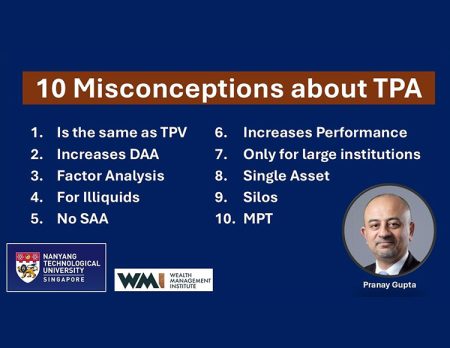
Myth 1 – Holdings look-through analysis (Total Portfolio View) is TPA. TPV can give you a better understanding of portfolio risks, but it is counterproductive for accountability and is not TPA.
Myth 2 – TPA increases dynamic allocation ability as SAAs are static. Governance aside, that is not true. You can deploy DAA to any extent in a SAA driven portfolio, funded or unfunded.
Myth 3 – TPA is factor analysis across asset classes which is then used by a quant team to run a factor overlay. Why would you concentrate the complete plan with a single active quant strategy?
Myth 4 – TPA is the same as combining private and public asset risk models. This is indeed one facet of TPA, but a small part of it. There is much more.
Myth 5 – TPA is a different philosophy than having an SAA. In reality, apart from a special case, TPA cannot be implemented without an SAA.
Myth 6 – TPA will deliver better performance than SAA. TPA is comprehensive framework and investment process aligned with the asset owner. It does not automatically increase skill, which is needed to increase performance.
Myth 7 – TPA is only for large institutions. TPA is in fact more useful for small and mid-sized asset owners, who don’t have internal resources, and suffer due to the agency problem with consultants, asset managers and analytic providers.
Myth 8 – TPA is only for multi-asset portfolios. TPA can in fact be deployed for single asset portfolios, as there is also a misalignment between client objectives and portfolio structure.
Myth 9 – TPA breaks down silos. Silos are a function of any organization structure. TPA cannot and does not change that.
Myth 10 – TPA is consistent with Sharpe-Markowitz. Modern Portfolio Theory is a reduced form special case of TPA- easy to understand and implement, but inconsistent with asset owner objectives.
The fact is that the traditional CMA – SAA – Manager selection process of managing portfolios is inconsistent with asset owner objectives and constraints, and that is what TPA solves. TPA is a full portfolio design and construction methodology which incorporates asset owner objectives and constraints by extending modern portfolio theory into a generalized framework, both for institutional and wealth.
But before you transition to TPA –
Caveat Emptor – Buyer Beware – Just like many now claim to be AI experts, many are claiming to know TPA, without ever having done it themselves. Before you hire a firm /individual for TPA, be sure you know yourself what TPA is (and more importantly what it’s not)!